, Mohamed Ramadan Mohamed 2
, Enas Abd Elmohsen Soliman Shaheen 1
, Ola Saeed Mohamed 1
, Mohamed Ramadan Mohamed 2
, Enas Abd Elmohsen Soliman Shaheen 1
, Ola Saeed Mohamed 1
2Department of Anesthesiology, Intensive Care, Damanhour Fever Hospital, Behira, Egypt
Abstract
Aim: Despite advances in intensive care, bacterial meningitis remains associated with high mortality among critically ill adults. Although cerebrospinal fluid (CSF) lactate is well established as a diagnostic biomarker, its longitudinal prognostic value remains uncertain.
Study Design: This prospective, single-center cohort study enrolled 45 adults with confirmed bacterial meningitis admitted to a tertiary ICU between June and December 2024. CSF lactate was measured at admission and again on day 14. The primary outcome was in-hospital mortality. Prognostic performance was evaluated using receiver operating characteristic (ROC) analysis with bootstrap-derived 95% confidence intervals (Cis) and Kaplan–Meier survival analysis.
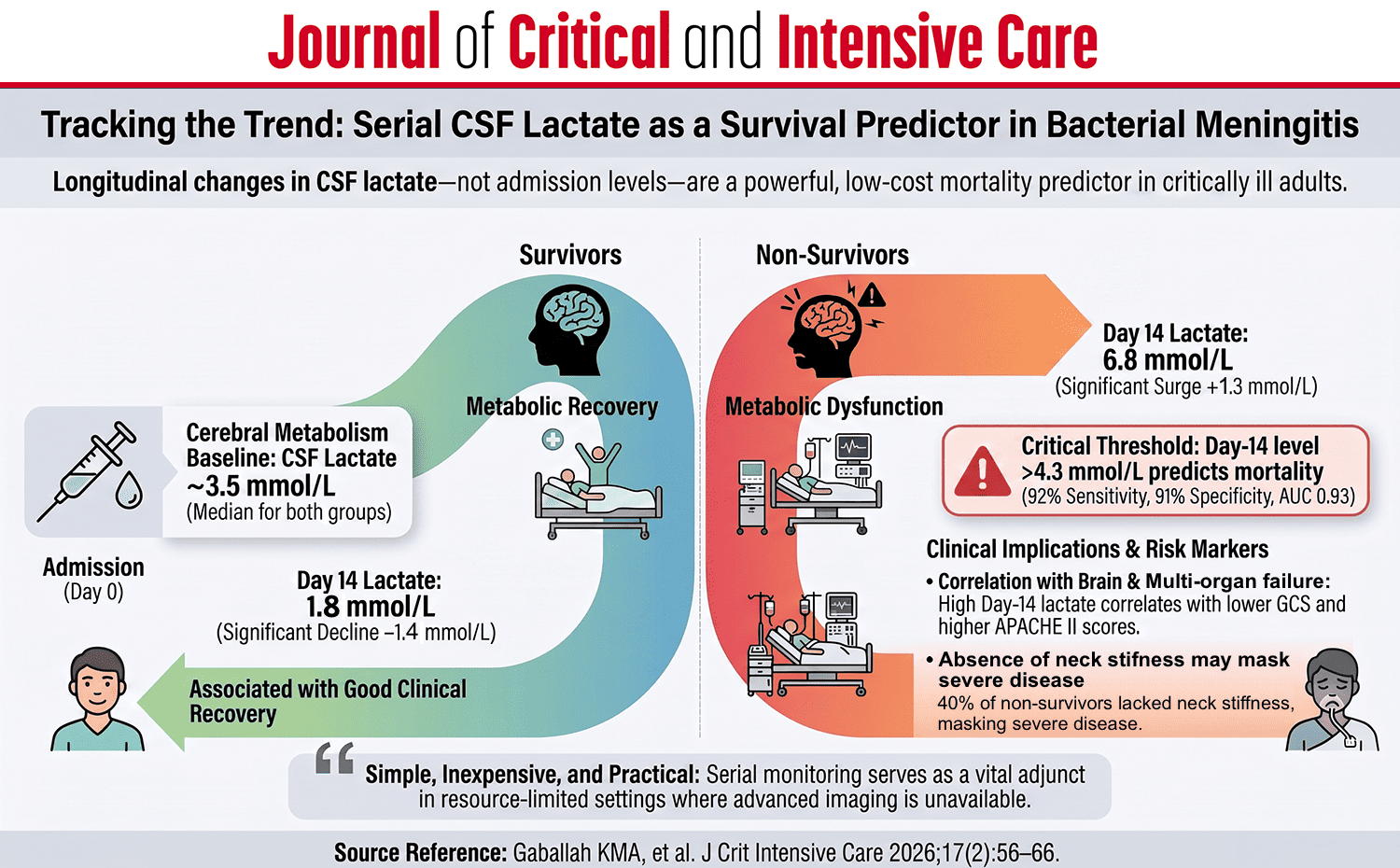
Results: Ten patients (22.2%) died during hospitalization. Compared with survivors, non-survivors were older and had lower Glasgow Coma Scale (GCS) scores and higher Acute Physiology and Chronic Health Evaluation II (APACHE II) scores. Among survivors, CSF lactate declined significantly from admission to day 14 (median Δ, −1.4 mmol/L, p<0.001), whereas non‑survivors demonstrated a significant increase (median Δ, +1.3 mmol/L, p<0.001). Day-14 CSF lactate strongly predicted mortality (optimism-adjusted area under the curve=0.93, 95% CI: 0.84–0.99; p<0.001). Patients with a CSF lactate >4.3 mmol/L had significantly lower survival than those with lower levels (log-rank p<0.001).
Conclusions: Persistent elevation of CSF lactate after two weeks of treatment identifies critically ill adults with bacterial meningitis who are at high risk of death, likely reflecting ongoing cerebral metabolic dysfunction. Serial CSF lactate monitoring may serve as a simple, inexpensive adjunct for prognostic assessment in ICU patients.
Graphical Abstract