, Amirreza Talebi 1
, Milad Mohammadi 1
, Tayyebeh Zarei 1
, Mehrdad Malekshoar 1
, Amirreza Talebi 1
, Milad Mohammadi 1
, Tayyebeh Zarei 1
, Mehrdad Malekshoar 1
Abstract
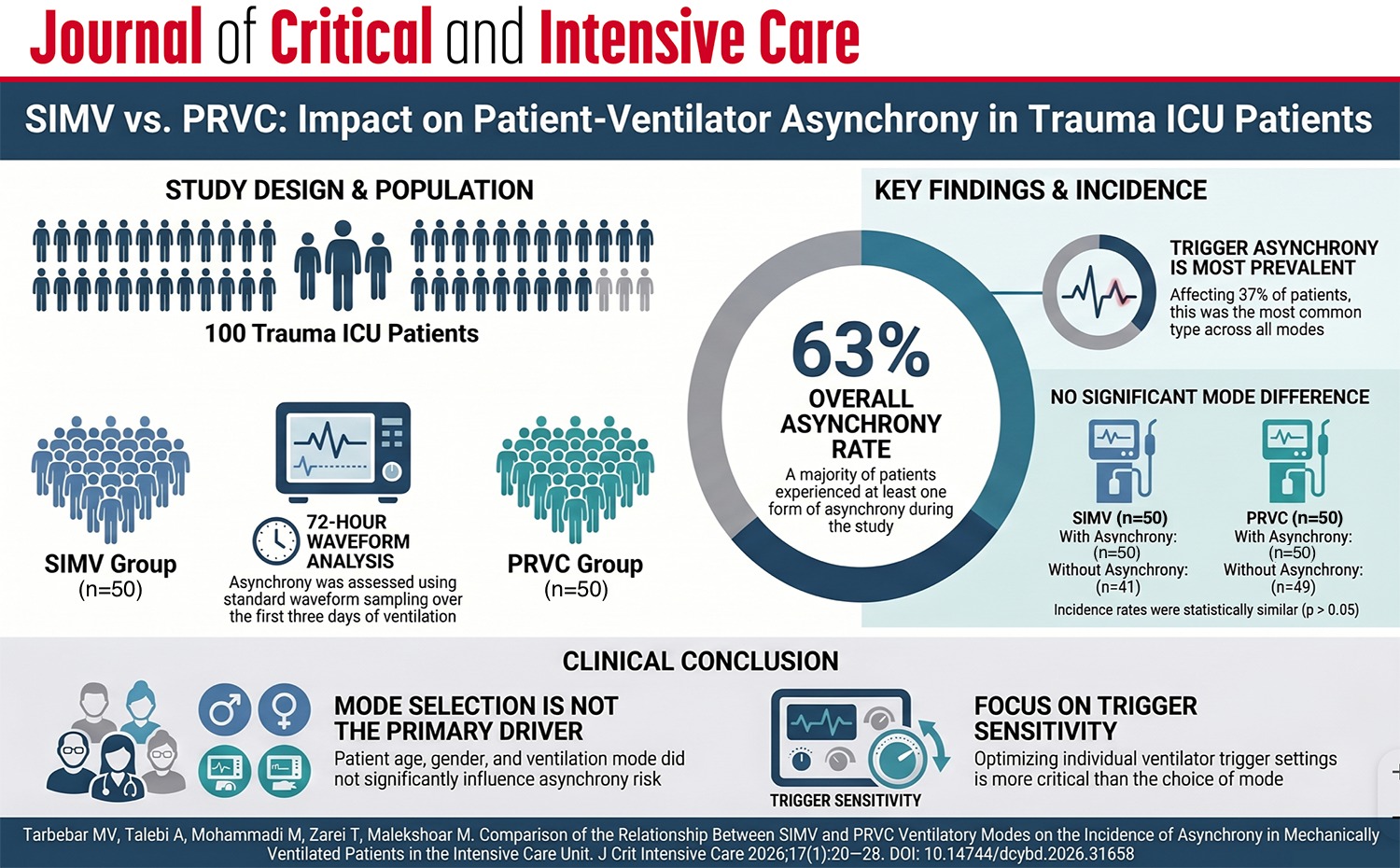
Aim: Patient–ventilator asynchrony (PVA), commonly occurring in mechanically ventilated patients, is a significant issue that contributes to increased discomfort, prolonged ventilation, and higher mortality rates. Among various ventilatory modes, Synchronized Intermittent Mandatory Ventilation (SIMV) and Pressure Regulated Volume Control (PRVC) are frequently used, yet their comparative effects on PVA remain unclear. This study aims to evaluate and compare the relationship between SIMV and PRVC ventilatory modes and the type and incidence of asynchrony in trauma patients in the ICU.
Study Design: This randomized, outcome-assessor-blinded clinical trial enrolled 100 mechanically ventilated trauma patients in the ICU of a hospital in southern Iran. Patients were randomly assigned to either SIMV or PRVC mode (n=50 in each group). Asynchrony was assessed over a span of 72 hours using standard waveform analysis. The overall incidence of asynchrony was chosen as the primary outcome, while specific types of asynchrony were considered secondary outcomes. Statistical analyses, including t-tests, chi-square tests, and ANOVA, were performed, with a significance level set at p<0.05.
Results: Asynchrony was observed in 63% of the patients. Trigger asynchrony was the most prevalent type, affecting 37% of patients. There were no statistically significant associations between the incidence of asynchrony and patient age, gender, or ventilation mode (p>0.05). The rates and distribution of asynchrony were similar for both SIMV and PRVC modes.
Conclusions: The significant occurrence of PVA underscores the need for careful, individualized adjustments to ventilator settings. The comparable results obtained with SIMV and PRVC modes suggest that optimizing trigger sensitivity may reduce the impact of mode selection, thus diminishing its importance in clinical decision-making.
Graphical Abstract